William Carey

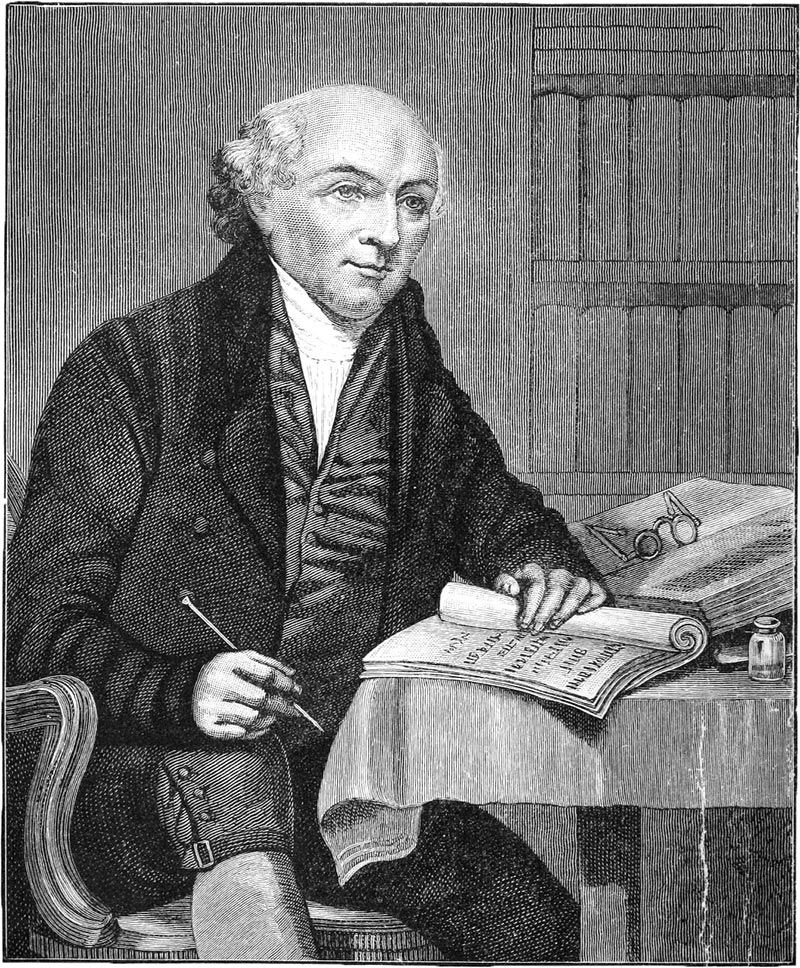
In 1783, the sensational, ‘Journal of Captain Cook’s Last Voyage to the Pacific Ocean’ was a treat to many people’s curiosity over amazing places and peoples. But one young man’s mind was thinking about world missions: “Are there so many places and people in the world who haven’t heard about Jesus yet?” He decided to do something about this vast need. At a meeting of church leaders in the late 1700s, this young minister argued for overseas missions. But he was abruptly interrupted by an older minister, "Young man, sit down! You are an enthusiast. When God pleases to convert the heathen, he'll do it without consulting you or me."
Soon, he set forth some of these compelling facts as a book and published his missionary challenge in 1792, An Inquiry into the Obligation of Christians to use Means for the Conversion of Heathens. His little booklet fuelled the formation of many missionary agencies across Europe and North America in the early 19th century. He himself sailed to India as a missionary in 1793 showing the way for hundreds and thousands of young men like Adoniram Judson, Hudson Taylor, and David Livingstone to follow his footsteps in later times. They were also inspired by his words “Expect great things from God, Attempt great things for God.” No wonder, he (William Carey) is called the Father of Modern Missions!
Early Influences
William Carey was born in Paulerspury village, near London. He was the oldest of five children. His father Edmund Carey was a weaver and also a school master. His mother, Elisabeth encouraged William to read. At a young age, William hungered for historical and scientific knowledge. Although lacked formal education after the age of 12 he continued to be self-educator and an avid reader.
While he was an apprentice to Mr. Nicholls to work as a cobbler John Warr, a fellow apprentice told William that he should know Jesus personally. He invited William to some meetings and also loaned books for reading. William attended a meeting and a message on Hebrews 13:13 led him to Christ. William learnt Greek, Latin, Hebrew, French, and Dutch. When he was a teenager, he could read the Bible in 6 languages.
In his cobbler’s stall, he hung a hand-made world map and wrote in it the details of the peoples and places which he knew through his readings. He prayed regularly to show the light of the Gospel to the people in darkness through someone. At that time, he did not know that he was one of the answers to his prayers.
His favourite scripture was Isaiah 54:5: “Thy Redeemer, the God of the whole earth shall He be called.” During his many years of ministry, and he was often found singing, praying, or meditating on verses of Isaiah 54.
Called to Mission
In 1785, William moved his family to Moulton, where he became the schoolmaster and continued his business. He also pastored a small Baptist congregation and preached in different Baptist churches. One of his friends cautioned him that he was neglecting his business by going for preaching. Carey replied, “My business is to extend the kingdom of God; I only cobble shoes to pay expenses.”
As William kept sharing his concerns for overseas missions on 2 Oct. 1792, the Baptist Missionary Society (BMS) was established. While considering to go as a missionary to Tahiti, he met John Thomas, a medical doctor, who worked in Bengal and knew the Indian languages and culture. He also read a letter from three Indians requesting preachers and those who would translate the Bible. These words redirected his plan to Calcutta.
Thomas and Carey reached India on 11 Nov. 1793 with much difficulty travelling for five months through the sea. After seven years of extremely difficult labour, in 1799, Joshua Marshman and William Ward joined him. These three are known as the Serampore Trio.

Contributions
William Carey taught Bengali, Sanskrit, and Marathi at Fort William College. He translated the entire Bible into Bengali, Sanskrit, and Marathi. Together with his team, Carey translated the New Testament and portions of the Scripture in about 40 languages and dialects; parts of Ramayana into English.
Carey, with his team, has written grammar and dictionaries in languages like Sanskrit and Bengali. He edited and published two works by horticulturist William Roxburgh, and helped distribute prose texts for use in schools. He is known as the ‘Father of Bengali prose.’ His work was so impressive, that in 1807, Brown University conferred a Doctor of Divinity degree on him.
He also . . .
founded Serampore College/ University in 1818 to train national leaders.
started the first India Newspaper, The friend of India, which is now known as The Statesman.
strived to abolish Sati (widow burning) along with Dr. Raja Ram Mohan Roy and a law prohibiting Sati was passed on 4 Dec. 1829.
opposed the children being thrown into the river Ganges to appease their gods.
founded the Agri-Horticultural Society in 1820 and did a systematic study of the plants in India.
started literacy for women and schools for the lower caste people along with Joshua Marshman and his wife Hannah.
led campaign for humane treatment for leprosy patients as he witnessed the lepers being thrown into a pit of fire and burnt alive.
introduced the concept of Savings Bank.
Challenges Overcame
His first sermon as an ordination candidate was rejected and thus his ordination got delayed two years. He faced opposition from the British East India Company which didn’t favour missions; repeated attacks of malaria and cholera; insufficient funds; losing three of his children to diseases, and his wife Dorothy who became mentally unstable until she died in 1807.
In 1812, a fire consumed the 15-year labour of Carey's translation. Carey was discouraged but with the team, he translated the materials again within seven years, yet much of the previous work was never reattempted. Carey waited seven years to see the first convert.

Legacy
During his last illness, Carey said to a friend, “You have been saying much about Dr. Carey and his work. After I am gone, please speak not of Dr. Carey, but rather of my wonderful Saviour.” By the time Carey died, he had spent 41 years in India without a furlough. William Carey rested in peace on June 9th, 1834, in Serampore. The worldwide missionary movement of the nineteenth century traces its inspiration to Carey.
References
John, Sam K. The Mission Driven Life. Bangalore: Operation Mission Focus, 2021.
https://www.britannica.com/biography/William-Carey. Accessed on 22 July 2021.
https://www.christianitytoday.com/history/people/missionaries/william-carey.html.Accessed on 22 July 2021.
https://www.wholesomewords.org/missions/bcarey3.html. Accessed on 24 July 2021.
https://www.christianitytoday.com/history/issues/issue-36/william-carey-did-you-know.html. Accessed on 24 July 2021.
https://www.christianity.com/church/church-history/timeline/1701-1800/william-careys-amazing-mission-11630319.html. Accessed on 2 July 2021.
https://bethanygu.edu/blog/stories/william-carey/. Accessed on 5 July 2021.


Comments